 nephraware
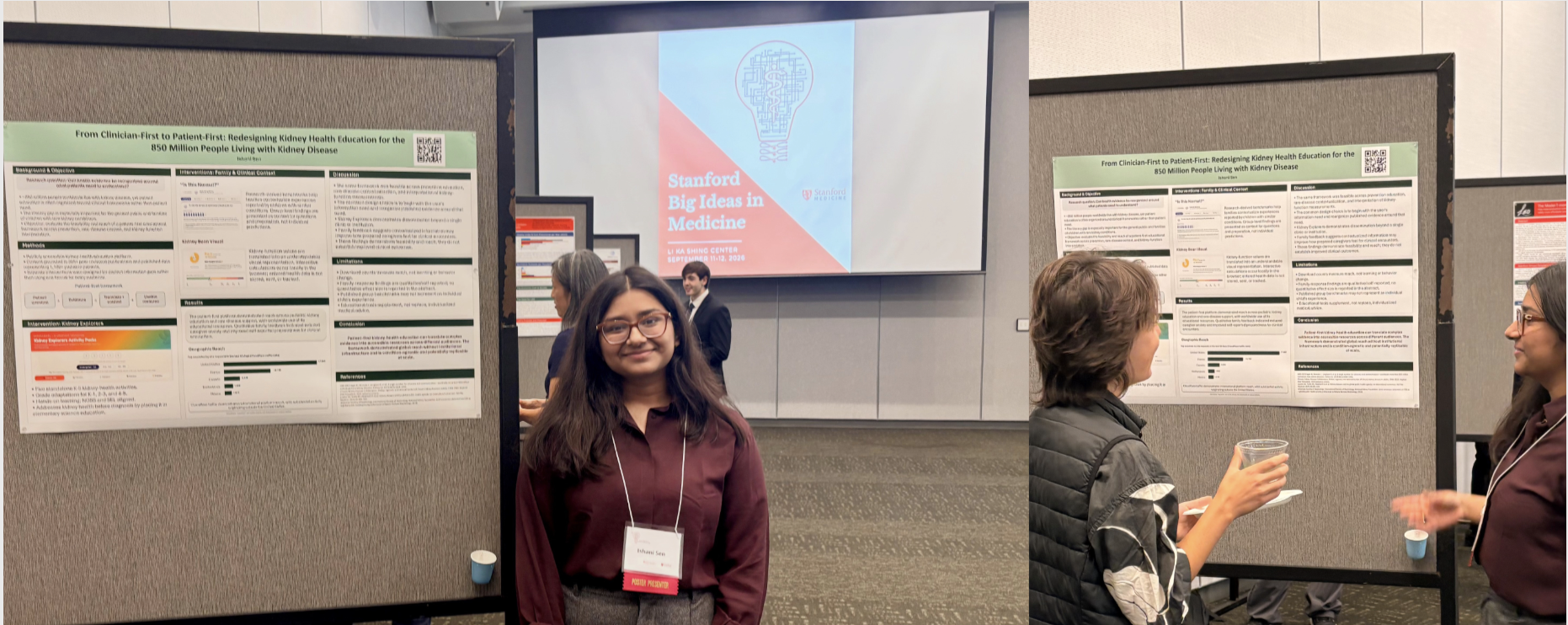
Background & Objective
Organizing health education around what patients actually need
~850 million people worldwide live with kidney disease, yet patient education is often organized around clinical frameworks rather than patient need. This literacy gap is especially important for the general public and families of children with rare kidney conditions.
Research question: Can health evidence be reorganized around what patients need to understand?
Objective: Evaluate the feasibility and reach of a patient-first educational framework across prevention, rare-disease context, and kidney-function interpretation.
Methods
A publicly accessible, evidence-grounded platform
Nephraware is a publicly accessible kidney-health education platform. Content is grounded in 285+ peer-reviewed publications and published data representing 1,100+ pediatric patients. Separate interventions were designed for distinct information gaps rather than using one format for every audience.
Patient-First Framework
Reorganizing evidence around patient questions
Rather than adapting clinical frameworks for lay audiences, the platform starts from the patient's question and works backward to evidence, translating it into a usable resource.
Platform Interventions
Three tools, one coherent experience
The platform's interactive layer is built around three clinically grounded tools that address the most common points of confusion for pediatric nephrology families.
Is This Normal?
A symptom and lab guide that helps families understand what's expected after diagnosis vs. what warrants a call to the nephrology team.
Explore the guide →Kidney Bean eGFR
A pediatric-specific eGFR calculator (Schwartz formula) that gives families a plain-language interpretation of their child's kidney function number.
Try the calculator →Educator Hub
School accommodation guides, IEP/504 language templates, and condition primers for school nurses and classroom teachers.
View educator resources →Geographic Reach
Global reach without institutional infrastructure
Cloudflare traffic data shows worldwide use of the platform's educational resources, with substantial activity originating outside the United States. Top countries by site requests in the last 30 days:
Cloudflare "requests" are traffic events, not downloads or unique visitors.
Results
Feasibility and reach
The patient-first platform demonstrated reach across pediatric kidney education and rare-disease support, with worldwide use of its educational resources. Qualitative family feedback indicated reduced caregiver anxiety and improved self-reported preparedness for clinical encounters.
Discussion
What this work demonstrates
- The same framework was feasible across prevention education, rare-disease contextualization, and interpretation of kidney-function measurements.
- The common design choice is to begin with the user's information need and reorganize published evidence around that need.
- Kidney Explorers demonstrates dissemination beyond a single clinic or institution.
- Family feedback suggests contextualized information may improve how prepared caregivers feel for clinical encounters.
- These findings demonstrate feasibility and reach; they do not establish improved clinical outcomes.
Conclusion
Condition-agnostic and replicable at scale
Patient-first kidney-health education can translate complex evidence into accessible resources across different audiences. The framework demonstrated global reach without institutional infrastructure and is condition-agnostic and potentially replicable at scale.
References
- GBD 2023 Jager KJ, Kovesdy C, Langham R, et al. A single number for advocacy and communication: worldwide more than 850 million individuals have kidney diseases. Kidney Int. 2019;96(5):1048–1050.
- Chronic Kidney Disease Collaborators. Global, regional, and national burden of chronic kidney disease in adults, 1990–2023. Nephrol Dial Transplant. 2026 (advance access).
- Luyckx VA, Tuttle KR, Abdellatif D, et al. Kidney disease and the global public health agenda: an international consensus. Nat Rev Nephrol. 2024;20:406–420.
- American Society of Nephrology, International Society of Nephrology, National Kidney Foundation. Joint consensus statement on CKD as a global public health priority. Referenced in Nature Reviews Nephrology, 2024.