 nephraware
Background & Objective
The content families find on TikTok may not be the content they need
Patients with chronic kidney disease increasingly turn to TikTok to seek health information. Short-form video platforms reward engagement rather than accuracy, so the most-viewed content may not be the most informative. Little was known about who creates CKD content, or whether expert involvement changes educational quality.
Research question: How does educational domain coverage compare between expert-backed and non-expert CKD content on TikTok, and who are viewers actually watching?
Objective: Evaluate CKD educational domain coverage across TikTok videos and compare expert-backed with non-expert content on coverage, engagement, and misinformation rate.
Methods
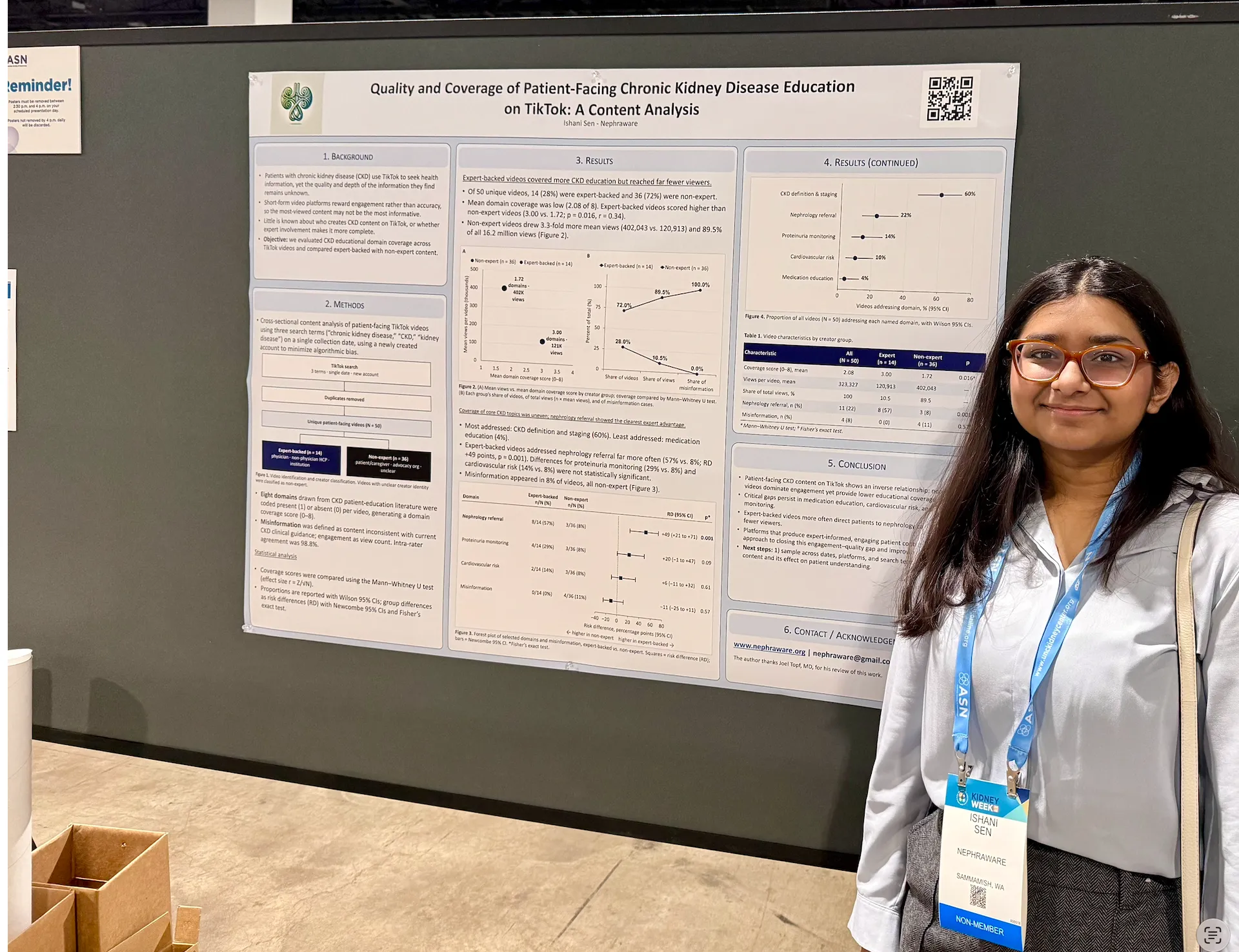
Cross-sectional content analysis of 50 patient-facing videos
Three search terms ("chronic kidney disease," "CKD," "kidney disease") were used on a single collection date with a newly created account to minimize algorithmic bias. After removing duplicates, 50 unique patient-facing videos were included.
Each video was classified by creator type: expert-backed (physician, non-physician HCP, or institution) or non-expert (patient/caregiver, advocacy org, or unclear identity). Eight educational domains drawn from CKD patient-education literature were coded present (1) or absent (0) per video, generating a domain coverage score of 0–8. Misinformation was defined as content inconsistent with current CKD clinical guidance. Intra-rater agreement was 98.8%.
Coverage scores were compared with the Mann–Whitney U test (effect size r = Z/√N). Proportions are reported with Wilson 95% CIs; group differences as risk differences with Newcombe 95% CIs and Fisher's exact test.
physician, non-physician HCP, or institution
patient/caregiver, advocacy org, or unclear
Results
Expert-backed videos covered more, but reached far fewer viewers
Mean domain coverage across all 50 videos was low at 2.08 out of 8. Expert-backed videos scored significantly higher than non-expert videos. Non-expert videos drew 3.3-fold more mean views and accounted for 89.5% of all 16.2 million views in the sample.
Coverage score and engagement, by creator group
| Metric | All videos (N=50) | Expert-backed (n=14) | Non-expert (n=36) | p |
|---|---|---|---|---|
| Coverage score (0–8), mean | 2.08 | 3.00 | 1.72 | 0.016 |
| Views per video, mean | 323,327 | 120,913 | 402,043 | |
| Share of total views | 100% | 10.5% | 89.5% | |
| Nephrology referral addressed, n (%) | 11 (22%) | 8 (57%) | 3 (8%) | 0.001 |
| Misinformation, n (%) | 4 (8%) | 0 (0%) | 4 (11%) | 0.57 |
Mann–Whitney U test for coverage score; Fisher's exact test for proportions.
Domain coverage was uneven across all videos
CKD definition and staging was the most commonly addressed topic. Medication education was almost entirely absent. Expert-backed videos showed the clearest advantage for nephrology referral.
Proportion of all 50 videos addressing each domain
Discussion
An inverse relationship between quality and reach
- Non-expert videos dominate engagement but provide lower educational coverage. Patients seeking CKD information on TikTok are most likely to find content with below-average educational depth.
- The most critical gap is medication education, addressed in only 4% of all videos, with no statistically significant difference between creator groups.
- Expert-backed videos are significantly more likely to direct patients toward nephrology care (57% vs. 8%), which matters because delayed referral is associated with worse outcomes in CKD.
- All misinformation cases came from non-expert videos, though the difference was not statistically significant given the small sample.
- Platforms that produce expert-informed, engaging content offer one approach to closing the engagement-quality gap and improving CKD health literacy.
Conclusion
The videos that reach patients most are not the videos that teach them most
Patient-facing CKD content on TikTok shows a consistent inverse relationship: non-expert videos dominate views while providing lower educational coverage. Critical gaps persist in medication education, cardiovascular risk, and proteinuria monitoring. Expert-backed videos more often direct patients toward nephrology care, but reach far fewer viewers.
Next steps include sampling across multiple dates, platforms, and search terms, and assessing the effect of content depth on patient understanding.
Acknowledgements
Thank you
The author thanks Joel Topf, MD, for his review of this work.